
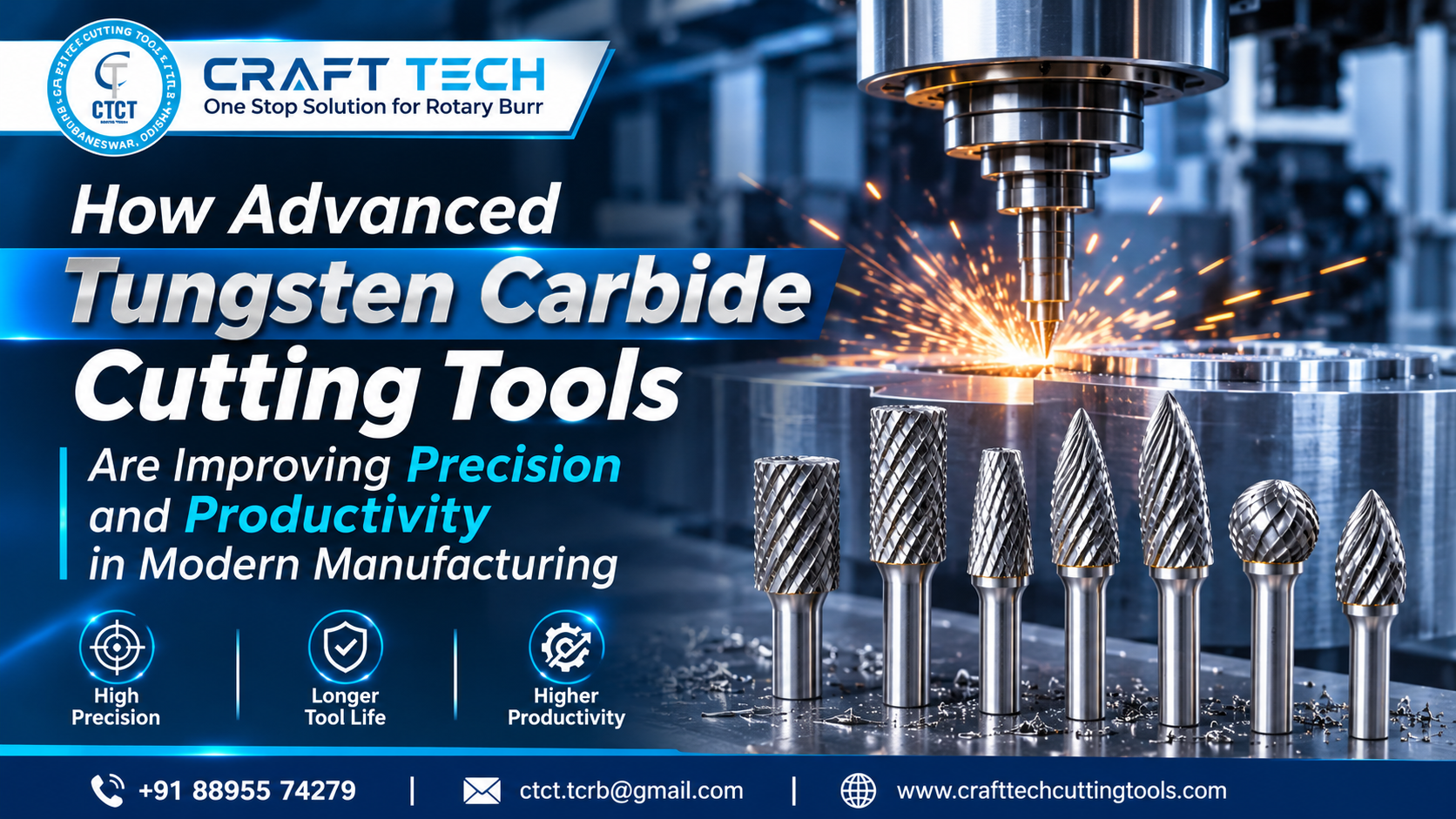
Tungsten Carbide Cutting Tools play an important role in modern manufacturing, where precision, durability and production efficiency are essential. From automotive components to heavy engineering applications, manufacturers depend on reliable cutting tools to achieve consistent machining results.
As industrial requirements continue to evolve in 2026, businesses are paying greater attention to tool performance, raw material costs and machining accuracy. Furthermore, the demand for reliable tooling solutions is encouraging manufacturers to focus on better product selection and tool-life management.
Tungsten carbide remains a preferred material for many industrial tooling applications because of its hardness, wear resistance and ability to perform under demanding working conditions. As a result, it continues to support several important metalworking and finishing operations.
Let’s explore how advanced carbide tooling, rotary burr technology and better tool selection are contributing to modern manufacturing.
1. Why Tungsten Carbide Cutting Tools Are Important in Manufacturing
Tungsten carbide has become an important material in industrial tooling because it combines high hardness with excellent wear resistance.
In addition to these properties, carbide tools can perform effectively in applications where durability and cutting performance are important.
Common industrial applications include:
- Metal cutting and shaping
- Deburring sharp edges
- Surface preparation
- Grinding and material removal
- Precision finishing
- Working on complex component profiles
However, the performance of a carbide tool depends on several factors, including its material grade, geometry, cutting configuration and operating conditions.
Therefore, choosing the correct tool for a particular application is essential for achieving consistent machining results.
2. Latest Cutting Tool Industry Developments in 2026
The cutting tool industry continues to experience changes in demand, material availability and manufacturing costs.
For example, a November 2026 industry report highlighted an increase in US cutting tool shipments, while also discussing challenges related to tungsten carbide raw material availability.
Read the industry update from American Machinist.
For industrial manufacturers, these developments highlight the importance of managing tooling costs without compromising machining quality.
Instead of focusing only on the initial purchase price, businesses should also evaluate tool life, machining performance, replacement frequency and suitability for the intended operation.
Consequently, a well-planned tooling strategy can help businesses make more informed purchasing decisions.
3. How Advanced Carbide Technology Supports Better Cutting Performance
Modern cutting tool development focuses on improving material properties and tool geometry.
In particular, manufacturers are exploring different carbide grades, surface coatings and cutting edge designs to address specific machining requirements.
Some important considerations include:
- Improved wear resistance
- Optimized cutting edge geometry
- Better chip removal
- Suitable coating technology
- Application-specific tool designs
For instance, selecting the correct geometry can improve the suitability of a tool for a particular material removal or finishing operation.
Moreover, the right combination of material and geometry can contribute to reliable machining performance.
For additional information about carbide tooling and machining solutions, explore ISCAR’s cutting tool technology resources.
4. Tungsten Carbide Rotary Burrs for Industrial Applications
Among the different types of tungsten carbide cutting tools, rotary burrs are widely used for shaping, deburring and finishing operations.
These tools are designed for use with compatible rotary machines. Furthermore, they are available in different shapes, sizes and cutting configurations.
Common industrial applications include:
Deburring: Removing sharp edges and unwanted material left after machining or fabrication.
Surface finishing: Preparing metal surfaces for further processing.
Material removal: Removing excess material from selected areas of a component.
Shaping: Working on different profiles, contours and edges.
Die and mould finishing: Supporting detailed finishing operations on complex components.
However, the correct rotary burr depends on the workpiece material, machine compatibility, required finish and machining conditions.
As a result, selecting the appropriate product is important for achieving the desired machining outcome.
5. Different Types of Rotary Burrs and Their Applications
Different machining requirements call for different rotary burr shapes. Therefore, understanding their profiles helps manufacturers select suitable tools.
Cylindrical Burrs
Cylindrical burrs are commonly used for working on flat surfaces, edges, slots and selected internal areas.
Additionally, their straight profile makes them useful for general metal removal and finishing operations.
Cylindrical Burrs With End Cut
These burrs feature cutting edges on both the cylindrical surface and the end face.
Consequently, they are useful for applications that require cutting action from the tool tip.
Cylindrical Burrs With Radius End
Cylindrical burrs with radius end feature a rounded end profile.
Because of this design, they are suitable for working around curved surfaces, contours and selected finishing areas.
Other Rotary Burr Profiles
Depending on the machining application, manufacturers may also use:
- Ball-shaped burrs
- Oval-shaped burrs
- Tree-shaped burrs
- Flame-shaped burrs
- Cone-shaped burrs
Ultimately, selecting the correct profile helps achieve the required material removal and finishing results.
6. Why Tool Life Management Matters for Industrial Buyers
Tool replacement and unexpected tool failure can affect production schedules and operating expenses.
For this reason, proper tool-life management is an important part of industrial operations.
Manufacturers can improve tool management by following a few practical steps:
Choose suitable tooling: Select the correct carbide grade and geometry for the application.
Follow operating recommendations: Use appropriate machine speeds and operating parameters.
Inspect tools regularly: Check for visible wear, damage and changes in cutting performance.
Maintain proper storage: Store cutting tools carefully to prevent unnecessary damage.
Avoid incorrect applications: Using a tool outside its intended purpose can result in premature wear or breakage.
Furthermore, modern CNC machining environments can use monitoring systems to identify changes in tool performance and support maintenance decisions.
As a result, better tool management can contribute to more predictable machining operations.
7. How to Choose the Right Tungsten Carbide Cutting Tools
Selecting suitable tungsten carbide cutting tools involves more than comparing product prices.
Instead, industrial buyers should consider several factors before making a purchasing decision.
Material compatibility: Is the tool suitable for the workpiece material?
Tool geometry: Does the shape match the intended machining operation?
Product quality: Is the tool manufactured to appropriate quality specifications?
Machine compatibility: Can the tool operate within the machine’s recommended conditions?
Manufacturer experience: Does the supplier understand industrial tooling requirements?
Technical assistance: Can the manufacturer help identify the right product for a particular application?
By considering these points, businesses can make better tooling decisions and choose products that match their production requirements.
8. Why Reliable Cutting Tool Manufacturers in India Matter
India has a diverse manufacturing ecosystem covering automotive, engineering, fabrication, foundry, forging and infrastructure industries.
As these sectors continue to develop, the need for dependable industrial tooling solutions remains important.
Businesses searching for reliable cutting tool manufacturers in India should evaluate manufacturing experience, product variety, quality consistency and application knowledge.
In addition, an experienced manufacturer can help industrial buyers understand different tooling options and identify products suitable for their machining requirements.
This is particularly important when selecting tungsten carbide rotary burrs for industrial shaping, grinding and finishing applications.
Conclusion: Choosing the Right Carbide Tool Makes a Difference
Modern manufacturing requires a careful balance between precision, productivity and operating costs.
Tungsten carbide cutting tools continue to support a wide range of industrial machining and finishing applications because of their hardness, wear resistance and versatility.
Nevertheless, achieving good results depends on choosing the right tool geometry, material specification and operating conditions.
At Craft Tech Cutting Tools, we understand the importance of dependable tooling in modern manufacturing.
Established in 2003, Craft Tech specializes in manufacturing tungsten carbide rotary burrs for various industrial applications. Our product range includes different burr shapes and cutting configurations to support diverse metalworking and finishing requirements.
If you are searching for a reliable rotary burr manufacturer in India, explore our product range and connect with our team to discuss your industrial cutting tool requirements.
Craft Tech Cutting Tools – Powering Precision. Delivering Performance.
Website: https://crafttechcuttingtools.com/
Phone: +91 88955 74279
Email: ctct.tcrb@gmail.com